Adoption of Digital Technologies
Enabling Adoption of Digital Technologies by Ontario Rainbow Trout Farms
-
Overview
-
Webinars
-
Resources
-
Publication
-
Policy
Rainbow trout aquaculture generates significant economic activity in rural Ontario. The industry has been very slow in adopting a number of digital technologies that could be of great value to improve its productivity. The experience of dairy and swine farming operations indicates that animal performance recording systems and production management software are highly valuable to support decision making and can thereby enhance the productivity of individual farms and the entire sector. The research employs social media data analytics, survey and key informant interviews and draws on 'technology acceptance model' and the ‘technology stewardship’ approach to map out the digital technologies available to Ontario trout farms and understand their adoption and features that enhance their value to the industry. The results will contribute to discussions on and actions regarding the analysis of best management practices and identification, assessment, and adoption of digital technologies for rural economic development.
- Webinar 1: Potential for Ontario Rainbow Trout Farms to adopt digital technology Date: 1:00 PM July 28th, 2022
Part 1 Presentation
Part 1: Panel discussion
This webinar aims to explore the option for rainbow trout producers to use technology that could significantly increase productivity. The Ontario Rainbow trout industry has a large potential for development. However, this industry is largely artisanal and would benefit from modernizing its practices.This webinar provides a chance to address what digital solutions are available to Ontario trout farms, what impediments to adoption exist, and how to create an enabling environment to accelerate the use of digital technology by rainbow trout farmers.
Part 1 focuses primarily on the opportunities and obstacles of digital technology adoption by Rainbow Trout Farm in Ontario, Canada.
Panel with: 1. Prof. Dominique Bureau, Department of Animal Biosciences (ABSc), University of Guelph; and Roy Hines - Norcan Electrical Systems Inc.
- Webinar 2 Enabling adoption of digital technologies in Ontario rainbow trout farms
Digital technologies can potentially revolutionize Ontario, Canada's rainbow trout farming sector. By automating and optimizing tasks, digital technologies can help to improve productivity, reduce costs, and enhance sustainability. However, the adoption of digital technologies in the Ontario rainbow trout farming sector has been slow. It is important to explore the factors that influ-ence the adoption of digital technologies in the Ontario rainbow trout farming sector to develop strategies to promote their adoption.
In Webinar 2, we discussed our survey results to explore the reasons for slow adoption and then validate them with a panel of experts. The webinar provide insights into the challenges and opportunities for adopting digital technologies in the Ontario rainbow trout farming sector.
Panel with: 1. Stephen Gunther, Director of Sales and Customer Success, Wittaya Aqua, Toronto, Ontario; 2. Tyler Sclodnick- Principal Scientist and Aquaculture Science Services Lead, Innovasea, Mississauga, Ontario, 3. Kana Upton - Aquacage Fisheries, Parry Sound, Ontario
- Video: The video is a snapshot of different digital technologies being adopted in Ontario rainbow trout aquaculture and related factors that influence the adoption
- Infographic
Current State of Digital Technology Adoption in Ontario Rainbow Trout Aquaculture
Publications
- Skilled workforce development and digital literacy are the most critical first-order interventions.
- A provincial data governance framework is urgently needed to address farmer trust and privacy concerns.
- Subsidies and financial incentives must be expanded and better targeted at small and medium-sized operations.
- Technology providers must be engaged as partners in adoption — not merely vendors — with accountability for ongoing support.
- Peer learning and demonstration programmes can shift attitudes and subjective norms at scale.
Ontario’s rainbow trout aquaculture sector — Canada’s largest, producing approximately 6,000 metric tonnes annually — stands at a critical inflection point. Mounting environmental pressures, rising production costs, and intensifying global competition make digital transformation not merely desirable but strategically necessary. Yet adoption of digital technologies, including Decision Support Systems (DSSs), Internet of Things (IoT) sensors, and AI-driven analytics, remains strikingly low across the industry.
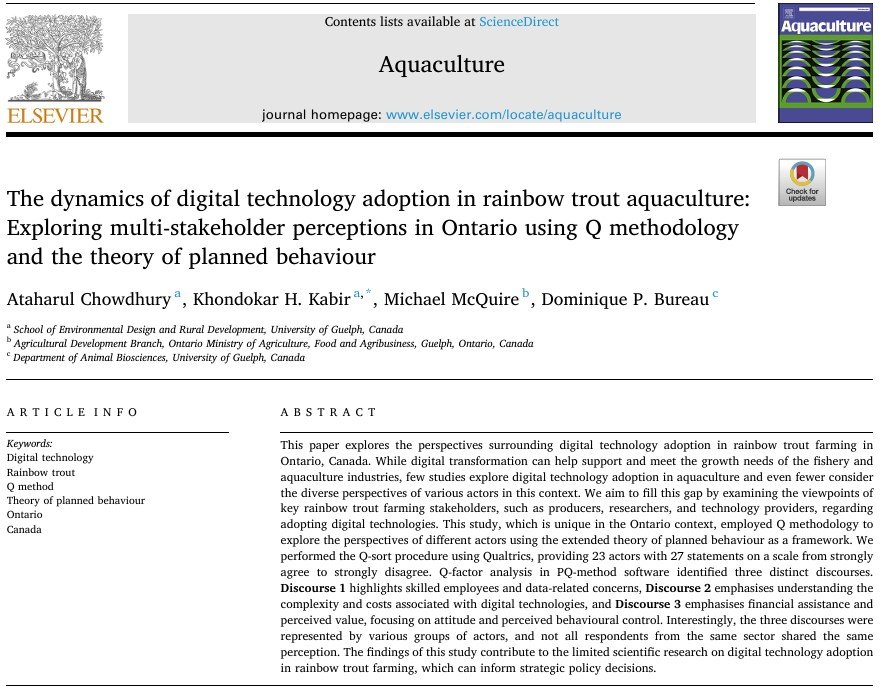
Two landmark peer-reviewed studies conducted at the University of Guelph illuminate the barriers and pathways forward. Using Q methodology and the Theory of Planned Behaviour (TPB), the first study identified three distinct stakeholder discourses shaping technology adoption attitudes. The second applied a rigorous SWOT-AHP-TOWS framework to 19 industry actors, revealing that external opportunities — especially cost savings and time efficiencies — significantly outweigh current barriers when strategically leveraged.
Rainbow trout farming is the cornerstone of Ontario’s freshwater aquaculture sector. Net-pen operations in Georgian Bay and the North Channel of Lake Huron account for 96% of provincial production, supporting rural employment, Indigenous economic development, and a growing domestic and international market expanding at 4.6% per year.
Despite this economic significance, digital technology adoption has stagnated. Research collected in 2023–2024 confirms Ontario lags behind analogous sectors in precision livestock and crop agriculture. Water temperatures in Lake Huron’s Manitoulin Island region have been rising steadily — making real-time environmental monitoring and predictive analytics survival tools, not peripheral improvements.
Using Q methodology and surveys of 23 industry actors — producers, researchers, input dealers, educators, and government officers — three coherent discourses emerged that cut across professional roles, underscoring the need for nuanced rather than sector-wide interventions.
All three discourse groups agreed on four consensus positions: (1) adoption requires radical changes to current farming practices; (2) there is little social pressure to adopt technologies for waste management; (3) digital technologies will increase farmer workload; and (4) data management limits the perceived value of digital tools. These consensus points should anchor any sector-wide communication strategy.
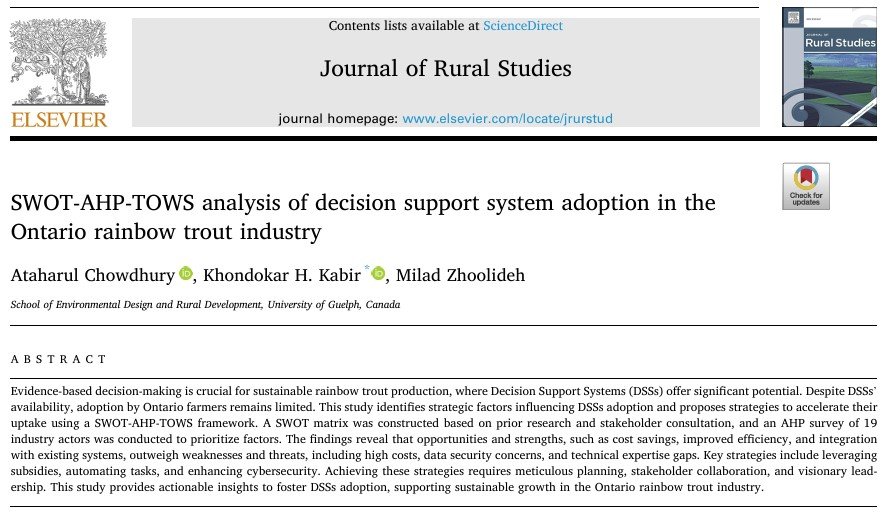
The second study applied the Analytic Hierarchy Process (AHP) to pairwise comparisons among 19 stakeholders, producing a clear quantitative hierarchy for strategic action.
- Seamless integration with existing farm management systems
- Easy data entry — reduces manual workload
- User-friendly web dashboards
- Robust support for day-to-day operations
- Limited customisation for farm-specific needs
- Data security and privacy vulnerabilities
- Requires trained human resources to operate
- Ongoing system monitoring burden
- Government subsidies available for digital tool adoption
- Integration across diverse farm operations
- Significant efficiency and productivity cost savings
- Time savings through task automation
- Cybersecurity risks: hacking, breaches, malware
- Growing data privacy concerns and farmer distrust
- High implementation costs and supply shortages
- Intensified market competition from widespread uptake
The AHP produced an unambiguous result: Opportunities (weight: 0.566) substantially outweighed Strengths (0.243), Weaknesses (0.123), and Threats (0.068). The dominant opportunity — efficiency and productivity cost savings (weight: 0.253) — was more than three times any individual weakness or threat factor.
Among all sixteen SWOT-derived strategies, ‘Automating Operations to Save Time and Enhance Productivity’ (SO2) ranked first, followed by SO4 and SO1. SO strategies collectively outperformed WO, ST, and WT strategies by more than 2:1, indicating the highest-return path is leveraging existing strengths against available opportunities.
Synthesising both studies, four primary barriers to digital technology adoption in Ontario rainbow trout aquaculture emerge:
Secondary barriers include limited DSS customisation for species-specific needs, increasing regulatory complexity and cybersecurity threats, and the transitional workload burden during implementation periods.
The following recommendations are sequenced by priority according to the AHP-weighted TOWS analysis. They are directed at the Ontario Ministry of Agriculture, Food and Agribusiness (OMAFA), the Ontario Aquaculture Association, and technology providers operating in the sector.
| Priority | Strategic Action | Lead Actors | Expected Impact |
|---|---|---|---|
1 | Develop and fund targeted digital literacy and training programmes for farm operators, covering core technologies (IoT, data analytics, AI) and data governance. | OMAFA, Ontario Aquaculture Association, Technology Providers | HighRemoves skilled labour barrier |
2 | Establish a provincial data governance framework — clear ownership rights, privacy protections, and third-party use regulations — specific to aquaculture digital data. | Ontario Government, Industry Associations, Legal Bodies | HighBuilds farmer trust |
3 | Expand and streamline access to subsidies and cost-sharing programmes for DSS and digital technology adoption, prioritising small and medium-sized operations. | OMAFA, Agriculture Canada, Ontario Trout Farmers Association | HighReduces financial barrier |
4 | Require technology providers to develop farm-specific customisation, standardised onboarding, and mandatory post-installation technical support protocols. | Technology Companies, Industry Associations, Government | Medium-HighImproves usability |
5 | Create and disseminate a repository of Canadian aquaculture DSS success stories and peer-to-peer demonstration events to build evidence of value. | Universities, OMAFA, Extension Services | MediumShifts attitudes |
6 | Invest in cybersecurity infrastructure for on-farm digital systems, including subsidised access to encryption tools, security audits, and threat response protocols. | Government, Technology Providers, Cybersecurity Partners | MediumReduces threat exposure |
- Training Gap AssessmentCommission a provincial audit of digital technology training resources and identify gaps in aquaculture-specific coverage.
- Data Governance Task ForceConvene a cross-sector task force to draft model agreement frameworks covering ownership, privacy, and third-party use.
- Subsidy ReviewReview and expand cost-sharing programmes to include explicit DSS and IoT eligibility for aquaculture operators.
- Digital Extension ServicesPilot a structured digital extension programme delivered jointly by government advisors and technology companies.
- Demonstration Farm NetworkEstablish at least two demonstration farms in Georgian Bay and the North Channel to showcase DSS functionality and document measurable ROI.
- Workforce PipelineCollaborate with post-secondary institutions to embed aquaculture digital competencies into diploma and degree programmes.
- Legislative ActionEnact provincial data governance legislation specific to aquaculture, with enforceable protections for producer data.
- Sector Transformation RoadmapDevelop a digital transformation roadmap with measurable targets, annual reporting, and accountability mechanisms.
Both studies are geographically restricted to Ontario and draw on relatively small samples — constraints that reflect the limited size of the provincial industry rather than methodological shortcomings. Future research priorities include:
Longitudinal studies tracking adoption attitudes over time as technology and subsidy landscapes evolve, providing dynamic rather than static policy intelligence.
Broader stakeholder representation in future SWOT-AHP exercises, particularly from operational managers, extension specialists, and Indigenous community aquaculture representatives.
Economic modelling of cost-benefit ratios at various operational scales to produce credible, concrete ROI projections for producers.
Cross-jurisdictional comparative research examining how analogous Canadian and international freshwater aquaculture sectors have overcome similar barriers.
Ontario’s rainbow trout aquaculture sector possesses the infrastructure, market position, and entrepreneurial capacity to lead a digital transformation that could redefine freshwater aquaculture productivity in Canada. The opportunities — cost savings, efficiency gains, productivity improvements, and climate adaptation through real-time monitoring — vastly outweigh the barriers.
The barriers are not primarily technological. They are human, institutional, and financial: a workforce that needs upskilling; a regulatory environment that has not kept pace with data-intensive farming; and cost structures that disadvantage smaller producers. Targeted, evidence-informed policy interventions will unlock the sector’s full potential.
- Fund a provincial Digital Aquaculture Training Initiative through the Ontario Agri-Food Innovation Alliance.
- Establish a Data Governance Task Force to draft model agreements for aquaculture digital data use.
- Audit and expand aquaculture-specific eligibility under existing technology adoption cost-sharing programmes.
- Partner with technology companies to mandate post-installation support as a condition of provincial procurement or endorsement.
This policy brief synthesises findings from the following peer-reviewed studies: