
1.1 Research Program: Participatory, Digital, and Data-Driven Capacity Development for Sustainable Agri-food Systems


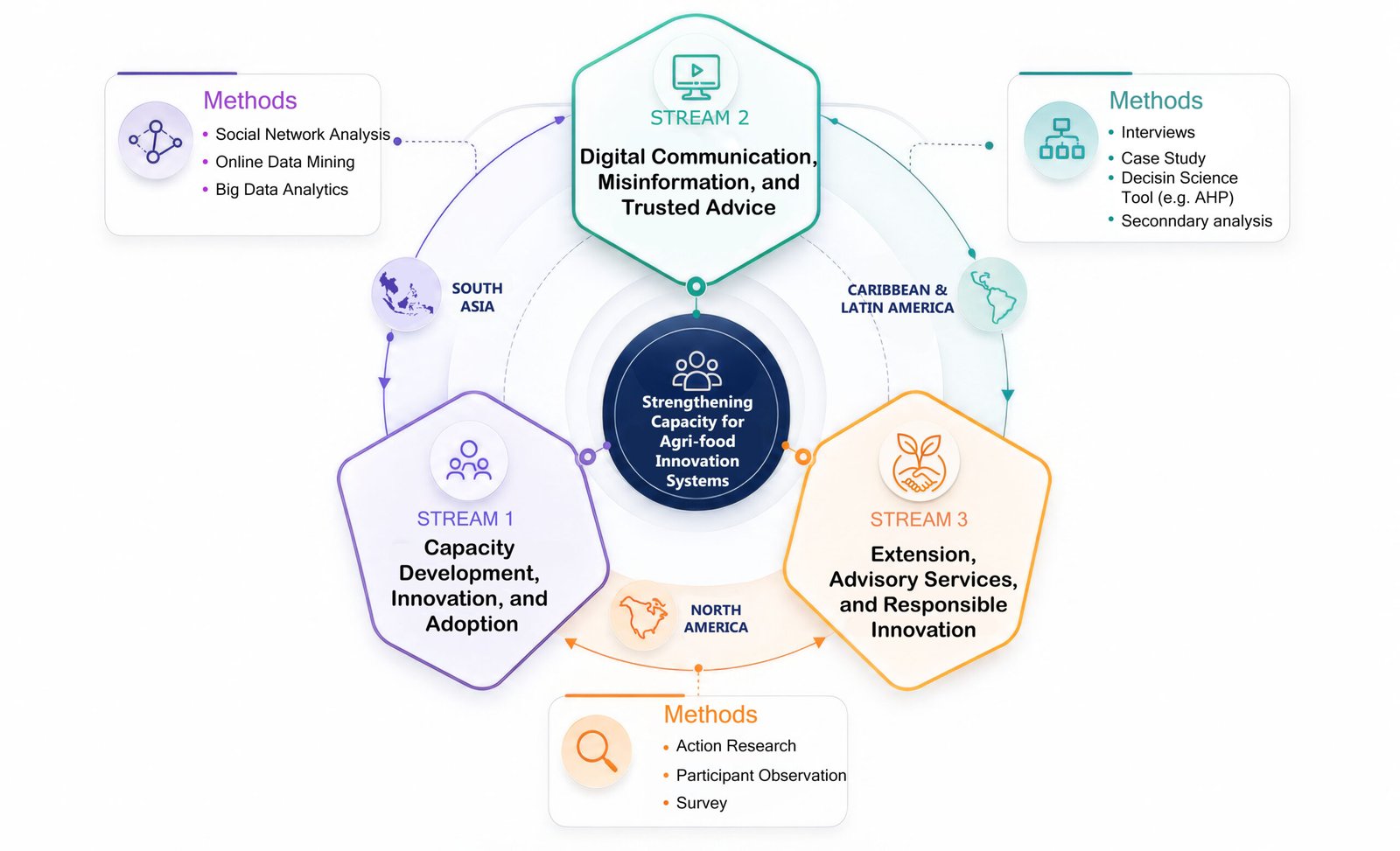
Figure 1: Research Framework
My research program (Figure 1) seeks to understand how individuals, communities, organizations, and institutions develop the capacities necessary to address complex challenges in agriculture, food systems, rural development, and environmental sustainability. Guided by the insights that innovation emerges through learning, communication, and collective action, my scholarship investigates how knowledge is generated, shared, mobilized, and transformed into meaningful social change. Through interdisciplinary and international collaborations, I examine the social, organizational, institutional, and technological factors that shape innovation processes and influence the resilience of agri-food systems.
My work is informed by a diverse but interconnected body of scholarship, including Agricultural Innovation Systems (Hall et al., 2006; Klerkx et al., 2012), Capacity Development Theory (Morgan, 2006; FAO, 2010), Social Learning Theory (Bandura, 1977), Communication for Development (Servaes, 2008), Communities of Practice (Wenger, 1998), Diffusion of Innovations (Rogers, 2003), Communicaiton and Innovation Theories (Leeuwis & Arts, 2021), Socio-Technical Transition Theory (Geels, 2002), Information Disorder Framework (Wardle & Derakshan, 2017), Risk Perception (Slovick, P, 1987; van der Linden, 2015; Siegrist & Árvai, 2020), Social Amplification of Risk Framework (Kasperson et al., 1988); Inoculation Theory (van der Linden et al., 2017); Mental Models Theory (Morgan et al., 2002). Together, these perspectives recognize innovation as a dynamic and socially embedded process that depends upon interactions among individuals, organizations, institutions, and technologies. Across all aspects of my research, I seek to understand how learning, communication, advisory systems, and technological change can contribute to more resilient, equitable, and sustainable agri-food systems.
Using mixed methods approaches, including surveys, social network analysis, participatory action research, systematic reviews, case studies, and digital analytics, I investigate how innovation emerges, spreads, and becomes institutionalized within agricultural communities. My research has informed policy and practice in Canada and internationally through partnerships with governments, universities, producer organizations, international development agencies, and global research networks. The research program theme has evolved into three interconnected streams (see Figure 1): (1) Capacity Development and Innovation in Agri-food Systems; (2) Digital Communication, Misinformation, and Trusted Advice; and (3) Extension, Advisory Services, Participatory Media, and Responsible Innovation in Agri-food Systems.
1.1.1 Capacity Development and Innovation in Agri-food Systems
The first theme examines how individuals, organizations, and institutions develop capacities that enable innovation, adaptation, and sustainable development within complex agri-food systems. This work is based on the Agricultural Innovation Systems scholarship, which views innovation as the result of interactions among various actors, including farmers, advisors, researchers, policymakers, and private sector organizations, rather than as a straightforward process of technology transfer. Complementing this perspective, Capacity Development Theory emphasizes strengthening the abilities of individuals, organizations, and institutions to identify challenges, mobilize resources, and achieve desired change, while Social Learning Theory highlights the importance of collective learning, reflection, and adaptation.
Within this framework, my research investigates how technical, organizational, institutional, and social capacities influence innovation processes in agriculture, rural development, and natural resource management. A significant contribution of this work has been the advancement of conceptual and practical approaches to strengthening capacity within agricultural innovation systems. Through collaborations with the Food and Agriculture Organization of the United Nations, CGIAR partners, the European Commission, and international partnership networks, I contributed to the development of the Common Framework for Capacity Development for Agricultural Innovation Systems. This framework has subsequently informed capacity development initiatives in more than twenty countries across Africa, Asia, and Latin America and has become an important reference for understanding how innovation capacities can be strengthened within complex agricultural systems.
My research has further examined pluralistic advisory systems, participatory forest management, climate adaptation, innovation networks, and institutional arrangements that support rural transformation. Representative contributions include studies examining the role of extension and advisory services in strengthening innovation networks for climate adaptation (Kamruzzaman et al., 2021), participatory forest management and institutional change (Kabir et al., 2021), social inequality and climate vulnerability (Khan et al., 2026), institutional climate risk management (Khan et al., 2023) and decision-support system adoption in Ontario aquaculture (Chowdhury et al., 2026), framework for investigating the adoption of Artificial Intelligence for agri-food innovation (Chowdhury & Edet, 2025). Together, these studies contribute to understanding how innovation systems can foster resilience, sustainability, and inclusive agri-food systems.
1.1.2 Digital Communication, Misinformation, and Trusted Advice
The second theme explores how digital communication technologies influence learning, knowledge exchange, innovation, and decision-making within agri-food systems. This work is informed by Communication for Development scholarship, Communities of Practice theory, Social Network Theory, and, more recently, Information Disorder Theory and Trust and Risk Communication scholarship. These perspectives provide important insights into how individuals and organizations exchange information, develop shared identities, establish credibility, and navigate uncertainty in increasingly digital information environments.
My interest in this area emerged through research examining how agricultural stakeholders use information and communication technologies to strengthen innovation networks and facilitate collaborative learning. Supported by an SSHRC Postdoctoral Fellowship and subsequent SSHRC-funded research, I investigated how social media and digital platforms create opportunities for relationship building, knowledge exchange, and collective action among agricultural communities. Early studies demonstrated how online communities of practice can extend learning networks beyond geographic boundaries and strengthen interactions among producers, advisors, researchers, and industry actors.
As digital communication became increasingly influential in shaping public discourse, my research evolved toward understanding misinformation, information disorder, and trusted advice within agri-food systems. Farmers, advisors, policymakers, researchers, and consumers now operate within fragmented information environments where evidence-based information frequently competes with misinformation, disinformation, and conflicting narratives. Understanding how trust is established, maintained, and challenged within these environments has become one of the defining issues facing agricultural communication and advisory systems.
I investigate how agricultural communities assess the credibility of information, identify trusted sources of advice, and respond to misinformation related to climate change, food systems, agricultural technologies, and sustainability transitions. This research has contributed to the development of analytical frameworks for understanding misinformation in agri-food systems and generated new insights into the roles of social networks, communities of practice, and advisory relationships in supporting evidence-informed decision-making.
Representative publications include a systematic review of misinformation in social and online media within the agri-food sector (Chowdhury et al., 2023), studies examining social media and agricultural innovation networks in Ontario (Kaushik et al., 2018; Chowdhury & Hambly Odame), extension agents’ use and acceptance of social media in Bangladesh (Kamruzzaman et al., 2018), effective use of ICT in agricultural extension (Gow et al., 2020) participatory communication in the digital age (Chowdhury & Gow, 2025). More recent work examines climate misinformation, information disorder, and trusted advice within Canadian and global agri-food systems (Kabir & Chowdhury, 2026; Kankanamge et al., 2025, Edet et al., 2026).
1.1.3 Extension, Advisory Services, Participatory Media, and Responsible Innovation in Agri-food Systems.
The third theme focuses on the role of extension and advisory systems in facilitating learning, innovation, and technological change. This work integrates Agricultural Extension and Advisory Systems Scholarship, Diffusion of Innovations Theory, Technology Acceptance Models, Responsible Innovation, and Socio-Technical Transition Theory. Collectively, these perspectives emphasize the importance of intermediary organizations and advisory relationships in facilitating innovation while recognizing that technological change is shaped by social, institutional, ethical, and political factors. Research within this theme has been supported by competitive funding from the Social Sciences and Humanities Research Council of Canada (SSHRC), the Ontario Agri-Food Innovation Alliance, the Livestock Research and Innovation Corporation (LRIC), the First Canada Research Excellence Fund (CFREF), and collaborations with CGIAR research programs and centers, reflecting the relevance of this work to advancing innovation and sustainability within Canadian and international agri-food systems.
My scholarship in this area originated with doctoral research investigating participatory video as a tool for agricultural innovation and community learning in Bangladesh. Drawing on participatory communication and action research traditions, I developed and tested a model of video-mediated learning that strengthened farmers’ capacities for experimentation, problem solving, and innovation (Chowdhury et al., 2011; Chowdhury et al., 2015). This work demonstrated how participatory communication can facilitate learning, empowerment, and collective action among resource-poor communities and received the Best Article Award from the Journal of Agricultural Education and Extension (Chowdhury et al., 2010).
Building on this foundation, my research expanded to examine broader questions concerning extension and advisory services, organizational transformation, innovation support systems, and advisors’ professional competencies. I have investigated how advisory organizations facilitate innovation, support climate adaptation, strengthen learning networks, and contribute to sustainable agricultural development. These efforts have been enabled by partnerships with producer organizations, government agencies, industry stakeholders, and research networks, and are supported by funding from SSHRC, the Ontario Agri-Food Innovation Alliance, and LRIC.
More recently, this work has evolved toward understanding the implications of emerging technologies for extension and advisory systems. Agriculture is experiencing unprecedented technological change through artificial intelligence, large language models, precision agriculture, digital advisory platforms, decision-support systems, and data-driven innovation. While these technologies offer significant opportunities for enhancing productivity, sustainability, and resilience, their successful adoption depends upon trust, governance, ethics, social acceptance, and institutional capacity. My recent scholarship, therefore, examines not only technological effectiveness but also the social conditions that enable responsible innovation. This emerging area of research has been strengthened through interdisciplinary collaborations supported by CFREF and other strategic funding initiatives focused on digital agriculture, sustainability, and innovation.
Representative publications include research on legal and ethical aspects of artificial intelligence in climate-smart agriculture (Uddin et al., 2022), social acceptance of large language models in agricultural extension and advisory services (Edet & Chowdhury, 2026), facilitating learning and innovation networks for climate adaptation (Kamruzzaman et al., 2022), pluralistic advisory systems in Ontario (Chowdhury & Kabir, 2024), and the transformation of public extension organizations to support innovation (Chowdhury et al., 2014). Collectively, this body of work contributes to understanding how advisory systems can facilitate responsible and inclusive innovation in rapidly changing technological environments.
1.2 Future Research Directions and Strategic Vision
My future research agenda seeks to advance a globally recognized program of scholarship on capacity development, trusted advice, digital transformation, and responsible innovation in agri-food systems. Building upon more than two decades of research in agricultural innovation, extension and advisory services, participatory communication, and capacity development, I aim to strengthen the University of Guelph’s leadership in addressing the social and institutional dimensions of sustainable agricultural development.
A central objective of my future research is to better understand how individuals, organizations, and communities navigate increasingly complex information, technological, and environmental landscapes. Agriculture is undergoing a profound transformation driven by climate change, digitalization, artificial intelligence, evolving consumer expectations, and rapidly changing policy environments. While technological innovations offer unprecedented opportunities for improving productivity, sustainability, and resilience, their success depends upon the capacities of individuals and organizations to learn, adapt, collaborate, and make informed decisions. My future research will therefore continue to focus on the human, organizational, and institutional dimensions of innovation and change.
A key priority is the continued development of the Capacity for Innovation (CAPInnov) initiative as a platform for interdisciplinary research, graduate training, and stakeholder engagement. CAPInnov provides an intellectual framework for integrating my research on capacity development, innovation systems, digital communication, misinformation, extension, and advisory services. Within CAPInnov, I am also advancing a dedicated research platform focused on misinformation, information disorder, and trusted advice in agri-food systems. This platform brings together researchers, extension and advisory professionals, policymakers, producer organizations, and industry stakeholders to investigate how misinformation emerges, spreads, and influences decision-making across agricultural and food systems. It also examines the social, institutional, and technological factors that shape trust, credibility, and the uptake of evidence-informed information. Through collaborations with researchers, policymakers, advisory professionals, producer organizations, and industry partners, I seek to generate new knowledge about how trusted advice is developed, communicated, and mobilized within agricultural innovation systems. Particular emphasis will be placed on understanding how trust, credibility, and expertise are established and maintained in increasingly fragmented information environments.
Building on recent SSHRC-supported research, I intend to expand investigations into misinformation, information disorder, and science communication within agri-food systems. Questions related to climate change, biotechnology, artificial intelligence, animal agriculture, and food systems are increasingly shaped by competing narratives and contested knowledge claims. Future research will examine how misinformation spreads through digital networks, how agricultural communities evaluate information credibility, and how advisory systems can support evidence-informed decision-making. This work has significant implications for agricultural policy, public trust in science, and the effectiveness of extension and advisory organizations.
A second major area of future research involves understanding the transformation of agricultural extension and advisory services in response to emerging technologies. Historically, extension systems have played a critical role in facilitating learning, innovation, and technology adoption. However, digital advisory platforms, precision agriculture, artificial intelligence, and large language models are fundamentally changing how information is generated, accessed, and utilized. My research will investigate how these technologies reshape advisory relationships, organizational practices, and decision-making processes within agriculture.
Particular attention will be given to the social acceptance and responsible use of artificial intelligence in agri-food systems. While AI-based tools have considerable potential to support decision-making, risk management, and knowledge mobilization, their successful implementation depends upon trust, transparency, accountability, ethics, and equity. Building on my recent work on AI ethics in climate-smart agriculture and social acceptance of large language models in extension and advisory services, I will examine how farmers, advisors, researchers, and policymakers perceive and utilize AI-enabled technologies. This research will contribute to emerging international discussions concerning responsible innovation and the governance of artificial intelligence within agriculture and food systems.
An additional priority is strengthening Canada’s leadership in extension, advisory, and rural innovation scholarship. To support this goal, I established the Canadian Agri-food and Rural Advisory, Extension and Education (CAREE) initiative, which includes the CAREE Conference and the CAREE Journal. These initiatives seek to revitalize extension and advisory scholarship in Canada by creating opportunities for dialogue and collaboration among researchers, practitioners, policymakers, industry representatives, producer organizations, and civil society actors. Building on the success of the inaugural CAREE Conference, which brought together participants from across Canada and around the world, I envision CAREE becoming a centre of excellence for advancing research, education, policy, and professional practice in agricultural extension, advisory services, communication, innovation, and rural development.
International collaboration will remain a defining feature of my future research program. Building on longstanding partnerships across Africa, Asia, Latin America, Europe, and North America, I will continue to engage with international organizations, development agencies, universities, and research networks to address global challenges in agricultural innovation, climate resilience, capacity development, and food security. These collaborations provide opportunities for comparative research, knowledge exchange, and mutual learning while ensuring that Canadian scholarship contributes to global discussions on sustainable development and agricultural transformation.
A final and enduring priority is the development of highly qualified personnel. Throughout my career, I have viewed graduate supervision and mentorship as integral components of my research program. Future initiatives will expand opportunities for graduate students to participate in interdisciplinary research, international collaborations, community-engaged scholarship, and knowledge mobilization activities. Through experiential learning and collaborative inquiry, I aim to prepare the next generation of scholars, educators, extension professionals, and policy leaders capable of addressing complex challenges at the intersection of agriculture, communication, technology, and society.