AI for Agri-food Innovation
Enabling Responsible AI-Driven Agri-Food Innovation in Ontario: Challenges and Opportunities
-
Overview
-
Webinars
-
Report
-
Publication
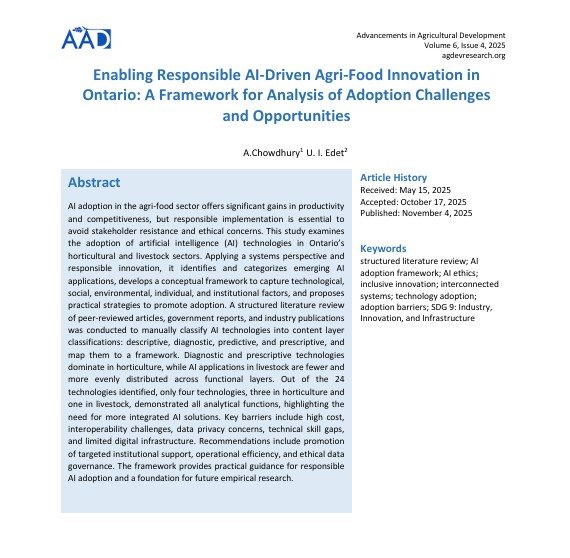
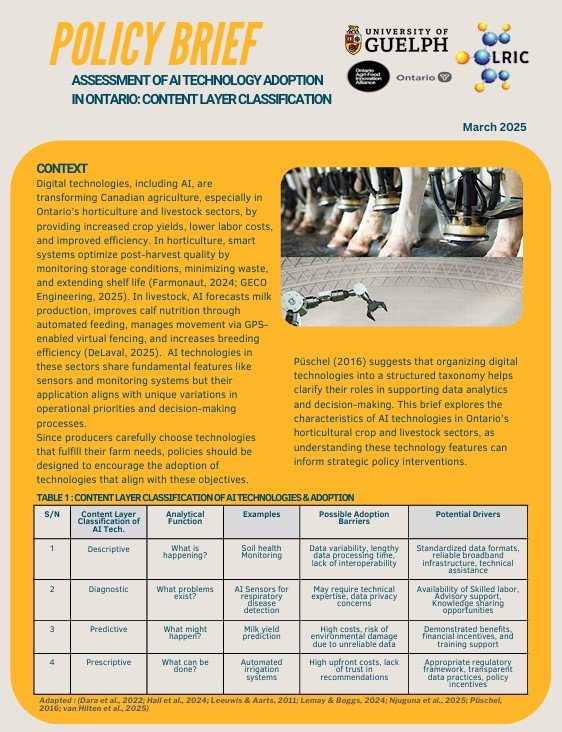
The adoption of artificial intelligence (AI) can enhance competitiveness and create new market opportunities in Ontairon’s agri-food sector. However, AI-driven AI should cater to responsible innovation that minimizes the challenges of job displacement, increased inequality, ethical concerns, and indifference to adoption. The adoption of AI varies across different sectors and value chains, and skills needed to thrive in the age of AI will vary depending on the specific AI technologies. Therefore, we should envision a future that complements and enhances existing knowledge, skills, and institutional support mechanisms. This research will use a mixed-methods approach to investigate the key factors influencing AI adoption in Ontario’s horticultural and livestock sectors, the associated challenges and opportunities, and the essential skills and knowledge for agri-food workers to thrive. The overall goal is to understand how AI can be used to improve the competitiveness and growth of Ontario’s agri-food sector within a responsible innovation framework.
Legal aspects of dealing with robot and AI tools in climate smart agriculture.
16 December, 2024,
This part was organized as part of the digital development, information integrity and inclusive innovation webinar series of agri-food, climate change and rural misinformation research platform.
Speakers and Panelists include,
Dr. Mahatab Uddin, who holds a Ph.D. in public international law, an adjunct professor and postdoctoral researcher at the University of Guelph. He specializes in climate change law, intellectual property, technology transfer, and sustainable development
Publications
Publications