AI for Agri-food Innovation
Enabling Responsible AI-Driven Agri-Food Innovation in Ontario: Challenges and Opportunities
-
Overview
-
Webinars
-
Publication and Report
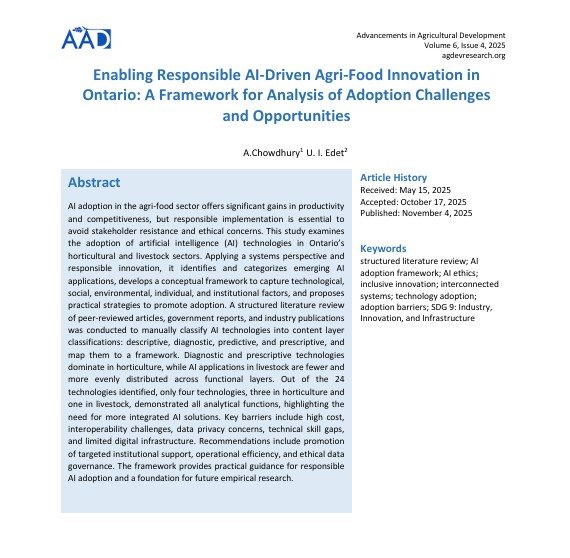
The adoption of artificial intelligence (AI) can enhance competitiveness and create new market opportunities in Ontairon’s agri-food sector. However, AI-driven AI should cater to responsible innovation that minimizes the challenges of job displacement, increased inequality, ethical concerns, and indifference to adoption. The adoption of AI varies across different sectors and value chains, and skills needed to thrive in the age of AI will vary depending on the specific AI technologies. Therefore, we should envision a future that complements and enhances existing knowledge, skills, and institutional support mechanisms. This research will use a mixed-methods approach to investigate the key factors influencing AI adoption in Ontario’s horticultural and livestock sectors, the associated challenges and opportunities, and the essential skills and knowledge for agri-food workers to thrive. The overall goal is to understand how AI can be used to improve the competitiveness and growth of Ontario’s agri-food sector within a responsible innovation framework.
Legal aspects of dealing with robot and AI tools in climate smart agriculture.
16 December, 2024,
This part was organized as part of the digital development, information integrity and inclusive innovation webinar series of agri-food, climate change and rural misinformation research platform.
Speakers and Panelists include,
Dr. Mahatab Uddin, who holds a Ph.D. in public international law, an adjunct professor and postdoctoral researcher at the University of Guelph. He specializes in climate change law, intellectual property, technology transfer, and sustainable development
AI Adoption in Ontario Agriculture
Policy Brief | March 2025
Overview
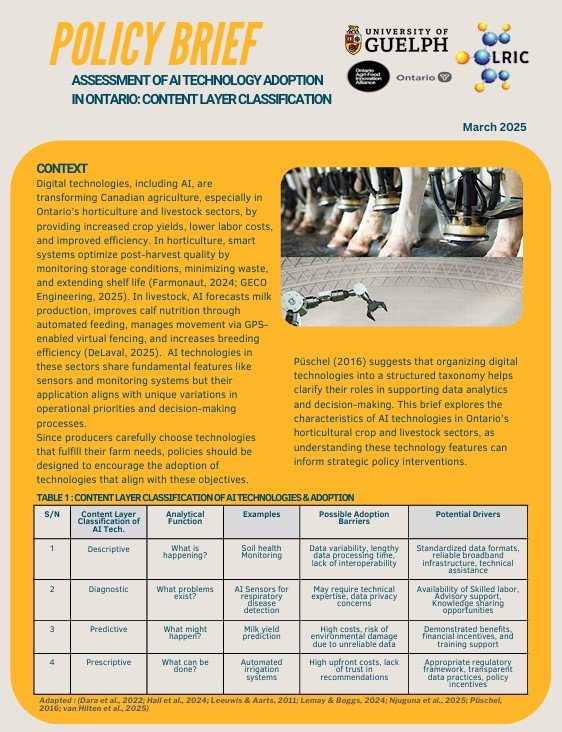
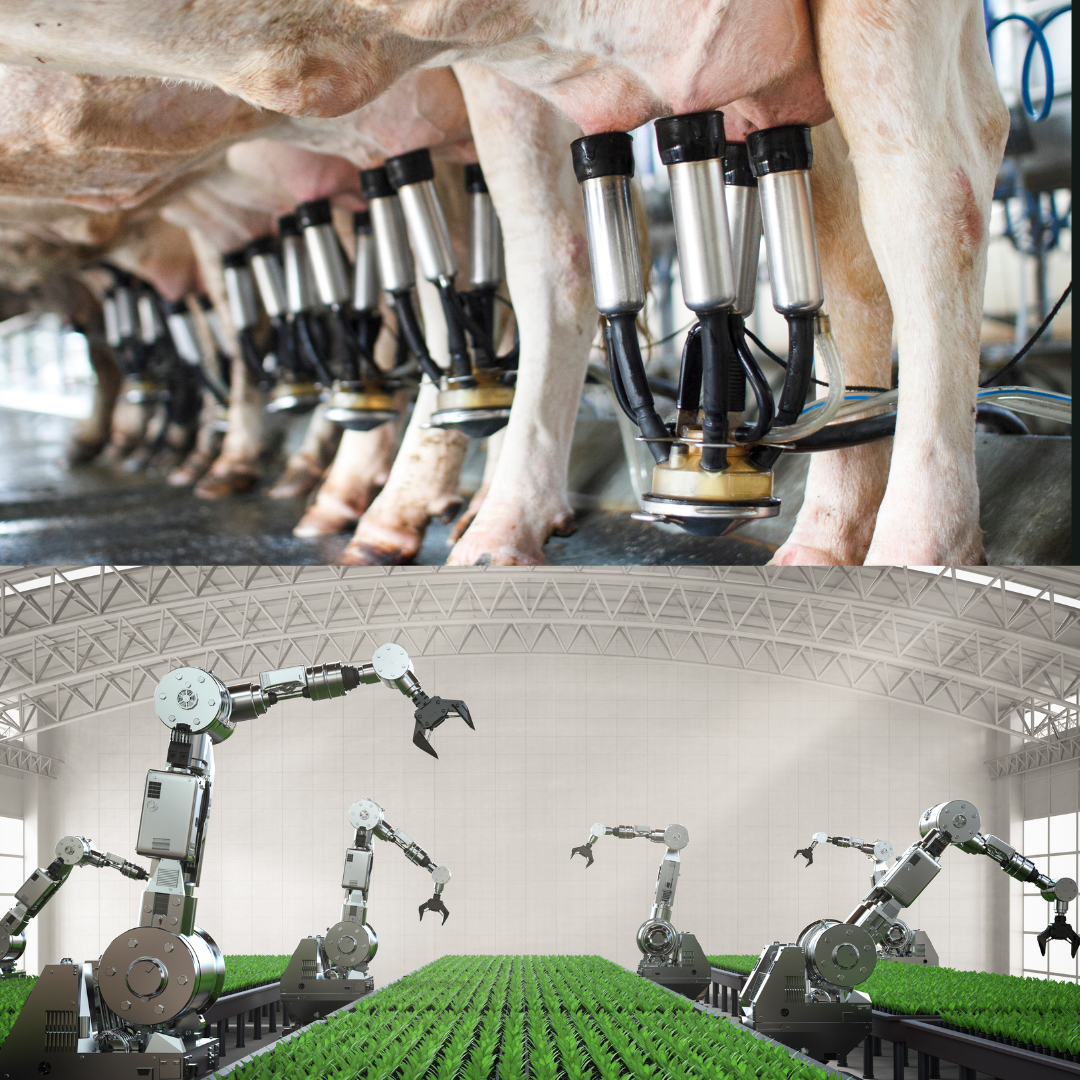
Digital technologies, including AI, are transforming agriculture in Ontario, especially in horticulture and livestock sectors. These tools improve crop yield, reduce labour costs, and enhance efficiency.
Smart systems optimize storage conditions, reduce waste, and extend shelf life, while livestock technologies improve feeding, breeding, and production forecasting.
AI Content Layer Classification
| Type | Function | Example | Barriers | Drivers |
|---|---|---|---|---|
| Descriptive | What is happening? | Soil health monitoring | Data variability, slow processing | Standardized data, broadband |
| Diagnostic | What problems exist? | AI disease detection sensors | Technical expertise, privacy concerns | Skilled labour, advisory support |
| Predictive | What might happen? | Milk yield prediction | High cost, unreliable data risks | Training, incentives |
| Prescriptive | What can be done? | Automated irrigation | High cost, lack of trust | Policy support, transparency |
Key Insights
Connectivity Challenges
Poor rural connectivity limits AI effectiveness. Investments in broadband and offline solutions are critical.
Data Standardization
Predictive tools require reliable data. Policies must ensure data quality, sharing, and transparency.
Technology Compatibility
Older farm equipment may not support AI tools. Incentives can help farmers upgrade.
Trust & Adoption
Farmers may hesitate to rely on AI. Education and clear regulations are essential.
Integrated AI Systems
AI technologies can work together across all layers—from data collection to automated decision-making—creating powerful integrated solutions.
Policy Recommendations
Financial Support
Subsidies and grants to reduce upfront AI adoption costs.
Technical Skills
Training programs to build AI expertise in agriculture.
Data Governance
Clear policies for privacy, transparency, and accountability.
Interoperability
Ensure AI systems can work together seamlessly.
Conclusion
Supporting integrated AI adoption and addressing technology-specific barriers will help unlock productivity, sustainability, and long-term innovation in Ontario agriculture.
AI Adoption in Agriculture
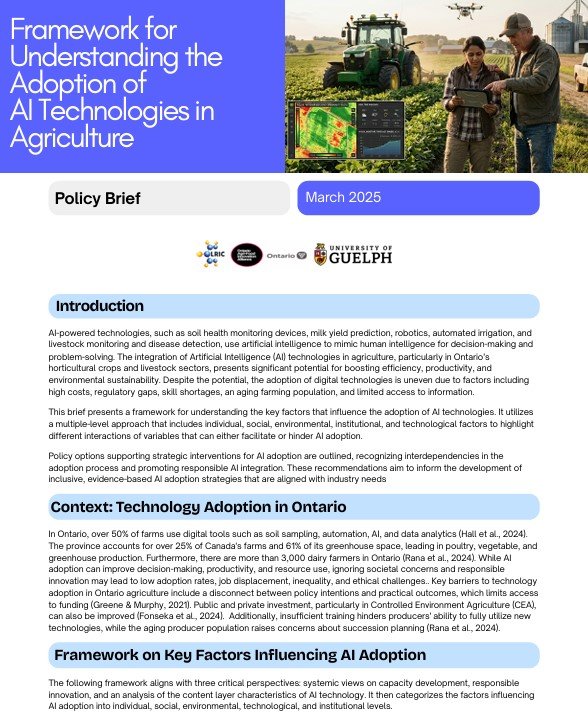
A modern framework for understanding how artificial intelligence is transforming Ontario’s agricultural sector—highlighting opportunities, barriers, and policy pathways.
Introduction
AI-powered technologies such as soil monitoring, robotics, automated irrigation, and livestock analytics are reshaping agriculture. These tools improve productivity, sustainability, and decision-making.
Ontario Context
Ontario leads Canada in greenhouse production and represents over 25% of farms. More than half of farms already use digital tools, but adoption challenges persist.
Adoption Factors
Individual
Knowledge, attitudes, and risk perception influence adoption decisions.Social
Peer influence and trust shape how farmers adopt AI tools.Institutional
Policies, broadband access, and regulations are critical enablers.Technological
Usability, reliability, and data quality determine effectiveness.Environmental
Sustainability and energy impacts influence long-term adoption.Policy Recommendations
Strategic Interventions
Tailor policies to address specific farmer needs through funding, training, and partnerships.Interconnected Approach
Recognize that adoption depends on multiple interacting social, economic, and technological factors.Responsible AI
Promote ethical, inclusive, and sustainable AI integration in agriculture.Way Forward
By fostering collaboration, responsible innovation, and inclusive strategies, Ontario can accelerate AI adoption and strengthen agricultural sustainability.